- Jul 5
A Sketchbook Will Allow You to Explore a Rabbit Hole
A daily sketchbook practice will let you discover thousands of different things you find interesting, but every once in a while, a discovery will lead you down a rabbit hole of your own curiosity, and your sketchbook will allow you to linger there, mapping it's edges, finding more and more treasures that hold your attention. You don't need to quit your job and abandon all previous pursuits for this adventure - a sketchbook will contain it not matter how big it gets.
My current sketchbook is full of plants, flowers and studies using both classical botanical painting techiques as well as more experimental mixed media pages. Last November I spent a morning painting a sketchbook spread with the last flowers of the season - they were white anemones with paper-thin, transluscent petals that were miraculously alive after the first frost. They were beautiful and resilient and I wound up feeling that I didn't know nearly enough about painting plants to do them justice. I started looking at botanical paintings from the past looking for technique, and stumbled onto an entire universe (new to me, but familiar to any botanical artist) of artists exploring the world through the prism of plants. A lot of these artists were women, who used botanical painting to survive independently in the male-dominated world of the 15th-19th cenuries. These women would travel the world, have access to famous scientists and philosophers and thrive financially at a time when most women were fully dependent on their husbands to survive. I picked up some technical tips for flower painting, but it was the stories behind the artists that drew me in - I kept painting, and kept reading, hooked on this world that was always there, but frequently on the edges of the "mainstream" art world, a world with it's own legends and patrons and superstars.
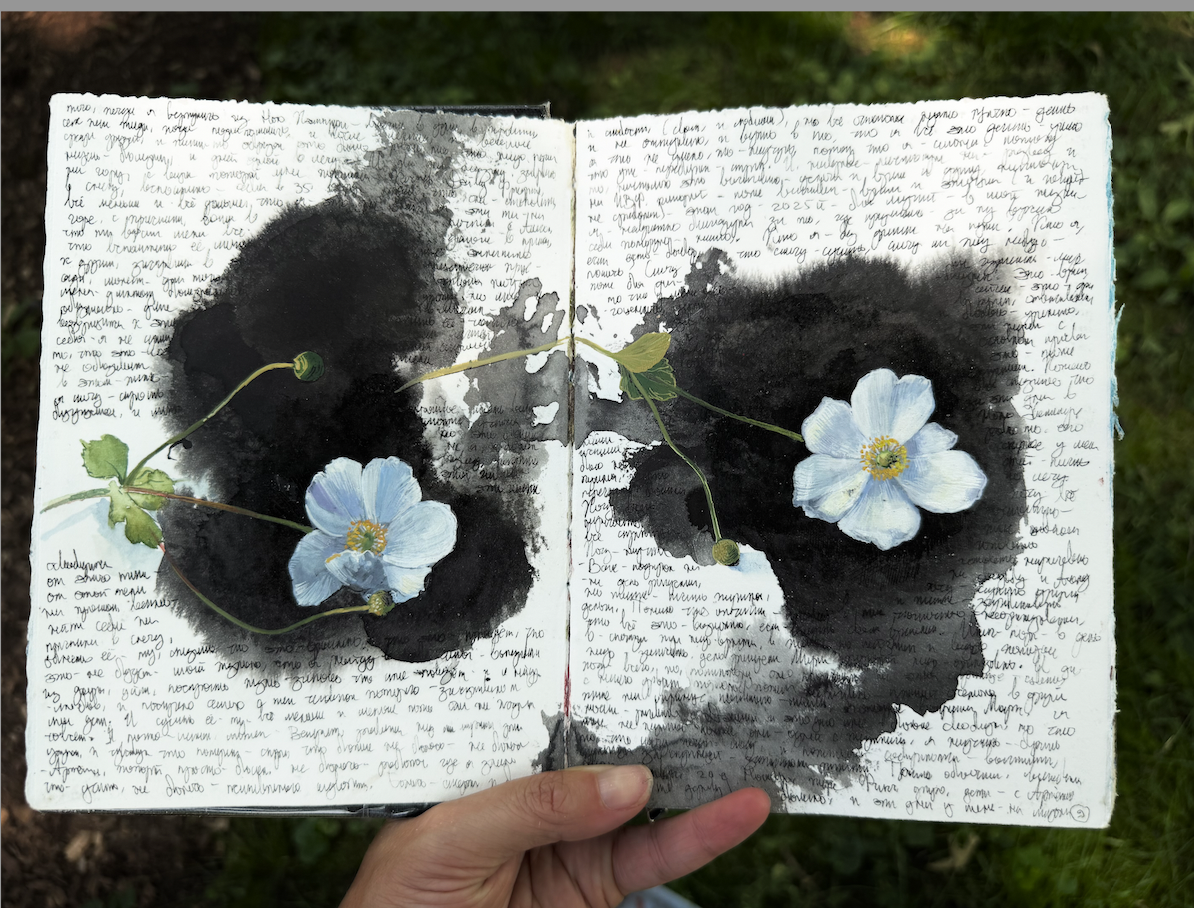
November anemones
My sketchbook began to fill with twigs, seedpods and dried leaves I found outside in the winter - I turned my morning sketchbook practice into a way to draw one plant each day. Eventually the drawings turned into paintings, and started becoming progressively more elaborate - I kept up with my 30 minute morning sketches before waking my kids up for school, but also started painting much more complex "portraits" of plants in my sketchbook. I found out which flowers make for the worst models (tulips and snowdrops move too much, opening at any sign of warmth), and which remain still and don't change for weeks. I became interested in the mythology behind the plants, as well as their properties - healing, poisonous, edible, magical.
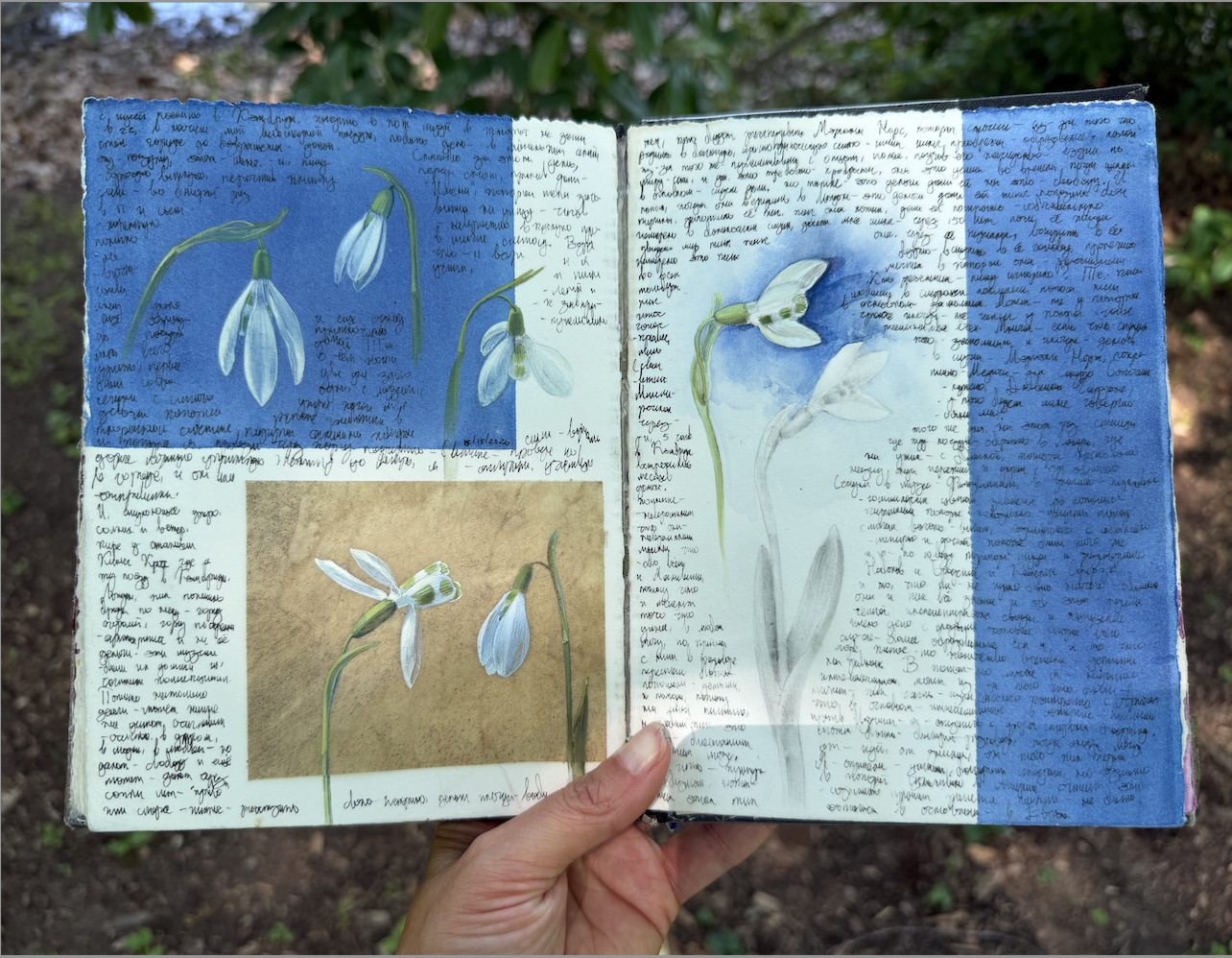
February snowdrops
The more I learned, the more interesting the world I was exploring became, like a castle that kept growing more rooms and turrets the further I moved into it. My sketchbook was my map to the castle, as well as my repository for all the things I was learning, my companion as I travelled new territory. I noticed that there were names that kept recurring, centers for botanical learning that employed artists and botanists through hundreds of years. The location that seemed to be the center of the spiderweb was Kew Gardens in London, so early this spring I decided to go there, to see the hundreds of thousands of plants, some of the oldest trees in London, as well as the art.
It was early spring, and maybe the best time to take a botanical tour of London - everything was in bloom, covered with spring's first flowers. Kew Gardens was everything I thought it would be, and more - the Shirley Sherwood gallery inside the botanical gardens has one of the best collections of historical and contemporary botanical art in the world, and right nearby the Victorian artist Marianne North built her own gallery once she came back from her solo travels around the world, to contain the 800 paintings she made on her travels - stepping into it is like stepping directly into her head and being able to see the world through her eyes. At a time when women were expected to be wives and homemakers, she was determined to see some of the most distant corners of the world, and paint them. She also had the money and the connections to be able to display it exactly the way she wanted once she got back to London, and being able to see her vision and her life's work in person was a wonder.
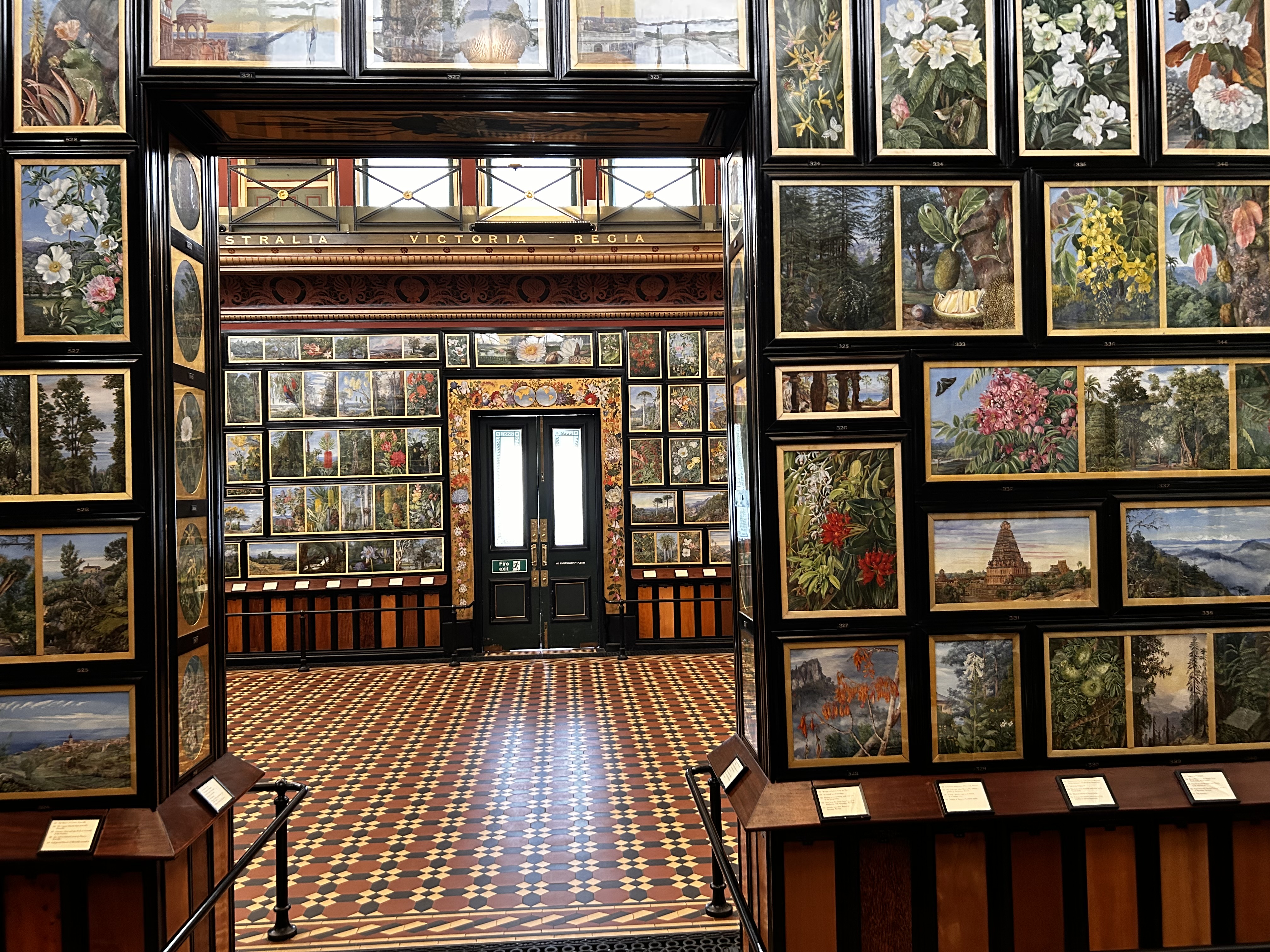
the Marianne North gallery, Kew Gardens
I spent the day wandering the botanical gardens, dazed with the beauty and immensity of it all. Eventually I found a field of tulips, and settled down to paint a purplish black Queen of the Night tulip, making a quick pencil sketch at first, then a blue underpainting which made it easy to build up the deep reds and purples on top. It wasn't a perfect painting, but it was a perfect moment, listening to the conversations of strangers, trying to catch the fragile beauty of a flower, in a place I'd been reading about for months, surrounded by hundreds of years of history and millions of plants.
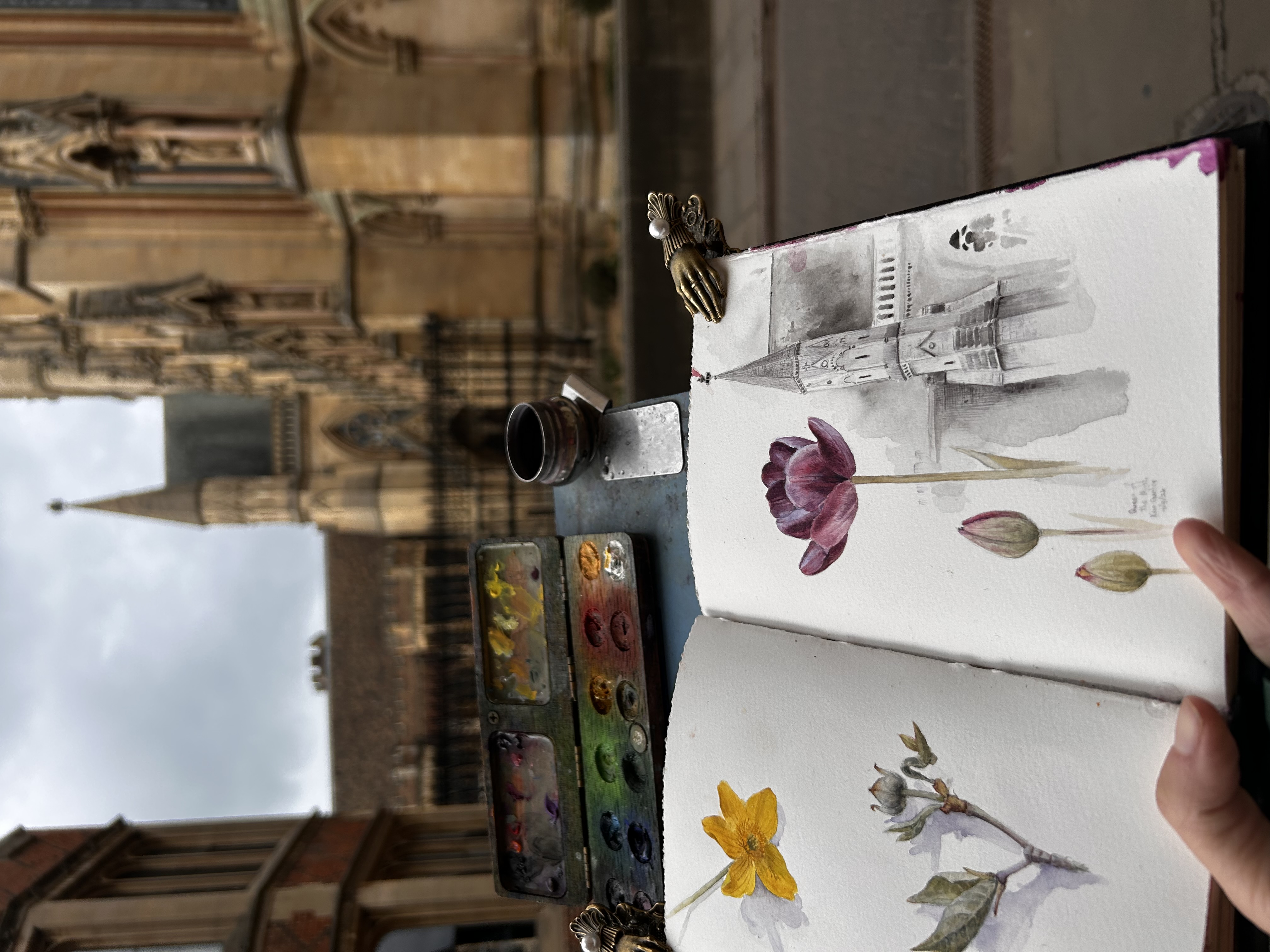
The Queen of the Night tulip from Kew Gardens, and one of the colleges in Cambridge
I spent the next few days on a botanical art quest around London, taking in the Dutch flower painting room (and everything else) at the National gallery, visiting the Chelsea Physick Garden where Marianne Blackwell drew the plants for her "Curious Herbal", getting to meet one of my favorite botanical artists, Svetlana Lanse, in person and look through a portfolio of her work up close. On my last day I took a day trip to Cambridge to see the Fitzwilliam museum's collection of Dutch flower paintings, which is one of the best in the world, and, for anyone who has seen it, possibly the most poorly curated, with masterpieces by Rachel Ruysch and others hung salon-style from floor to ceiling, making it impossible to see the details ot take in the work by any artist hanging higher than eye level. I stopped by the Cambridge botanical gardens a bit after the flowering of the moonflower cactus, the plant that Margaret Mee spent fifteen years hunting down in the Amazon to be able to paint it on the one night a year that it blooms.
All this was sparked by a sketchbook page in November - it led me down a rabbithole, and I followed, like Alice, marvelling at the wonders of it all, at how much there is to learn, how many human stories are intertwined with the stories of plants, filling page after page with plants that I've walked past thousands of times without looking closely. That sketchbook is almost finished now, and it contains my year, as seen through the prism of plants. Here's the last page, from early mornings over the last few days:
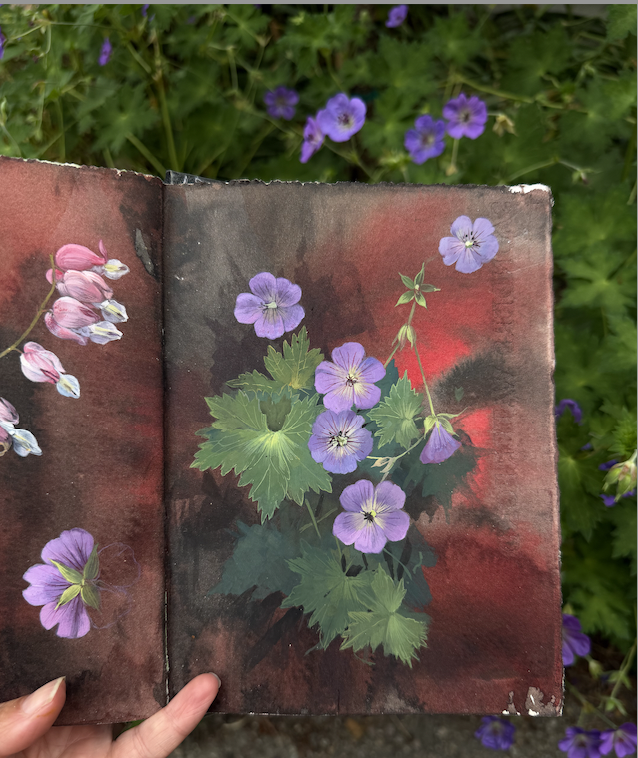
Rozeanne geraniums and bleeding hearts
Dina Brodsky
"I believe that the act of keeping a sketchbook journal has been one of the most important decisions I have taken in my life as an artist. My sketchbooks are the heart of my studio practice, my travel companions, my place to play and explore. They have served as a way of developing my skills, and a method of examining my life, the place where I discovered who I was, and created the person I wanted to be. I’ve kept sketchbooks consistently for almost 25 years, and during that time they’ve provided a sanctuary when I needed a place to retreat, and catharsis when I needed change.I want to share everything I’ve learned throughout my sketchbook practice, to explore the universe of artist sketchbooks, and to help others develop a sketchbook practice of their own."